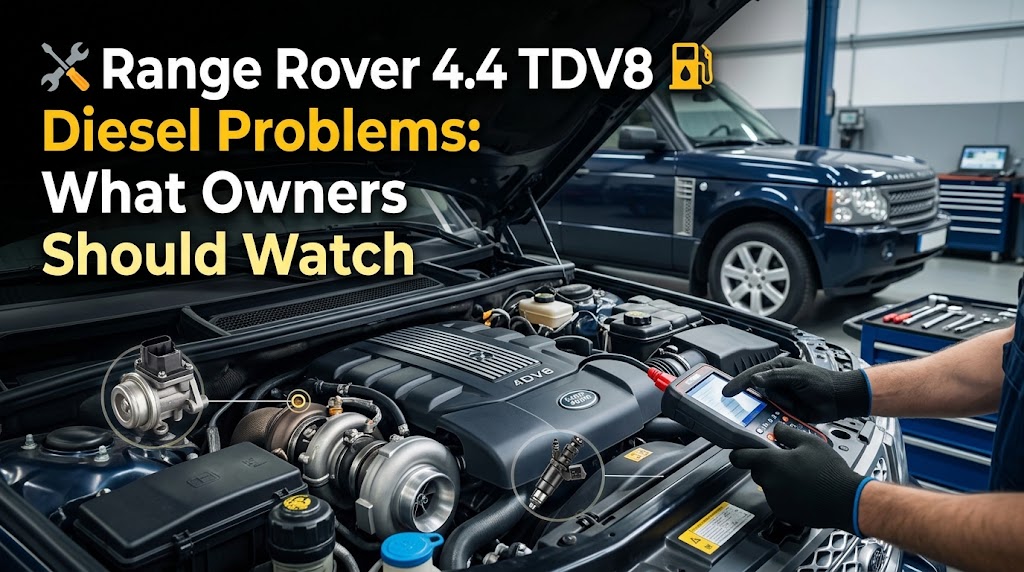
Most Range Rover 4.4 TDV8 problems come down to five things: turbocharger failure, oil and oil cooler leaks, EGR valve and cooler faults, worn injectors and a blocked diesel particulate filter. They start small and get expensive only when they are ignored. The earlier 3.6 TDV8 shares most of them and adds a bottom-end concern of its own, so this guide covers both engines.
Key takeaways
Table of Contents
Toggle- Restricted turbo oil pipes cause most turbo failures on these V8 diesels.
- Short Dubai trips stop the DPF regenerating, where most limp-mode faults begin.
- Coolant loss or oil in the coolant points at the oil cooler or an EGR cooler.
- The 3.6 TDV8 has the weaker reputation for crankshaft bearings.
Range Rover Repairs Dubai handles these V8 diesel jobs for owners across Dubai.
Which Range Rovers used the 3.6 TDV8 and 4.4 TDV8/SDV8
The 3.6-litre TDV8 (368DT, 272 PS) arrived in the L322 Range Rover for the 2007 model year and ran to about 2010, with the same engine in the Range Rover Sport L320.
The 4.4-litre V8 diesel (448DT) replaced it: L322 from 2010 to the end of production in 2012, then the L405 and Range Rover Sport L494 from 2013, badged SDV8. No V8 diesel was fitted to the L460 or L461 (2022 on), and the Velar and Evoque never used one.
The Range Rover 4.4 TDV8 problems we see most
Turbochargers
Both engines run two variable-geometry turbos in the V, fed and drained by narrow oil pipes close to very hot metal. Carbon restricts the feed or drain, the bearings starve and the turbo fails; on the 4.4 the secondary turbo drain is the known weak spot, revised during production. Listen for a whistle rising with boost, blue-grey smoke, oil in the intercooler pipework and limp mode.
Oil leaks and oil cooler leaks
The oil cooler sits in the V and carries oil and coolant close together; when it fails internally the two mix, leaving a creamy residue in the expansion tank. External leaks are usually rocker cover gaskets, turbo oil pipes, the filter housing or crank seals, and 45–50°C summers harden that rubber fast.
EGR valves and coolers
A V8 has two EGR valves and two coolers, all handling soot. A sticking valve gives rough idle, hesitation and an engine light; a cracked cooler pushes coolant into the exhaust as white smoke. Crawling traffic is the worst duty cycle for both, because exhaust temperatures never rise enough to burn soot off.
Injectors
Injectors wear and can leak at the seat, baking a black crust around the injector body. Expect rough cold starts, a knock, smoke and a misfire code on one cylinder. Diagnosis means leak-off testing and live correction values; new injectors must be coded to the ECU.
Crankshaft and bearing concerns
Crankshaft bearing wear is widely reported on the 3.6 TDV8, which is why its oil history matters at purchase. The 4.4 has the better reputation, though we will not claim a factory revision without a source. On either engine a deep rumble at idle, an oil pressure warning or metal in the oil means stop driving; that repair is engine-out.
DPF clogging in Dubai traffic
The DPF traps soot and burns it off. Passive regeneration needs sustained high exhaust temperature; when that never happens, the ECU injects extra fuel to force an active regeneration.
Villa to office, office to mall, fifteen minutes each way with the AC on maximum rarely gives that regeneration time to finish. Interrupted regenerations are worse than none, because unburnt fuel dilutes the engine oil, which then attacks the turbo bearings.
Owners see a DPF light, then higher fuel use, then reduced power. At the light stage a sustained run often clears it; at limp mode it needs a scan, a forced regeneration, or cleaning or replacement.
How we deal with this in our workshop
Our technicians start with a full diagnostic scan on dealer-level equipment — stored codes, live boost, fuel and DPF data — instead of replacing parts on symptoms. A restricted turbo oil drain and a blocked DPF often turn up together, so we find the root cause first, then explain the options and the price before work starts.
Diesel fuel quality and filter changes
These engines run very high injection pressures and dislike water or dirt in the fuel. Coastal humidity and a car that sits for weeks both encourage condensation in the tank, and many diesel Range Rovers here are imports that have done exactly that.
Change the fuel filter on schedule rather than stretching it, and check air filters early, because fine sand loads them faster than the interval assumes. Filters, coolers and turbo pipework come through Range Rover parts Dubai in genuine and OEM-equivalent options.
3.6 TDV8 vs 4.4 SDV8: issue comparison
| Issue | 3.6 TDV8 | 4.4 SDV8 | Symptom |
|---|---|---|---|
| Turbo oil feed/drain coking | Common | Common, secondary drain | Whistle, smoke, limp mode |
| Oil cooler leak | Common | Common | Oil and coolant mixing |
| EGR valve sticking | Common | Common | Rough idle, engine light |
| EGR cooler cracking | Reported | Reported | Coolant loss, white smoke |
| Injector seat leak | Common at high mileage | Reported | Cold-start knock, black crust |
| DPF blockage | Yes | Yes | DPF light, high fuel use |
| Crank bearing wear | Widely reported | Better reputation | Rumble at idle, low oil pressure |
| Gasket and seal leaks | Common with age | Common with age | Burning oil smell, drips |
Habits that extend engine life
- Take one sustained run a week so the DPF can regenerate fully.
- Idle for thirty seconds after a hard run so the turbos cool with oil flowing.
- Use the correct low-ash diesel oil, and change it early if you only do short trips.
- Watch the coolant level; it is where a cooler leak shows first.
- Replace air and fuel filters on time — dust here is harder duty than the schedule assumes.
What this work typically costs in Dubai
These are typical Dubai prices published online by UAE sources, the top of each range reflecting main-dealer level pricing. Our prices are typically 30–70% less than main dealer prices.
| Job | Typical Dubai price | Range Rover Repairs Dubai |
|---|---|---|
| Turbocharger replacement | AED 5,000–15,000 | AED 4,500–10,500 |
| DPF cleaning | From AED 800 | Typically 30–70% less than main dealer prices |
| DPF replacement | AED 5,000–10,000 | AED 3,000–7,000 |
The final price depends on model, engine and parts choice — the lower end of our range reflects OEM-equivalent parts and simpler jobs, genuine parts sit at the upper end — and we confirm it on WhatsApp after diagnosis. For jobs not listed, such as EGR coolers, injectors or an oil cooler, we quote after the scan rather than publish a figure, and that pricing is also typically 30–70% less than main dealer prices.
When to see a specialist
Stop driving: a rumble low in the engine, an oil pressure warning, or metal in the oil.
Stop driving: coolant disappearing with white smoke, or oil and coolant mixing.
Book now: a whistle rising with boost, blue-grey smoke, or oil in the intercooler pipes.
Book now: a DPF light that will not clear, repeated limp mode, or rough cold starts.
Range Rover Repair in Dubai with Range Rover Repairs Dubai
Range Rover Repairs Dubai is an independent Range Rover and Land Rover specialist workshop, not a dealership and not affiliated with Jaguar Land Rover. We run dealer-level diagnostic equipment, so a limp-mode fault on a 3.6 or 4.4 V8 diesel is read properly — stored codes, live boost and fuel data, DPF soot loading — instead of being guessed at.
We fit genuine and OEM parts and explain the difference before you choose, so you decide where the money goes. Our prices are typically 30–70% less than main dealer prices, and we offer pickup and delivery across Dubai if you would rather not drive a car already down on power. You get a clear quote on WhatsApp before work starts. For Range Rover engine repair that combination matters: proper diagnosis, an honest parts choice and a fixed price up front are what stop a turbo or DPF job becoming an open-ended bill, and they are the core of how we handle Range Rover repair in Dubai.
Bottom line
These V8 diesels are strong engines that are unforgiving about oil, heat and short journeys — the three things Dubai supplies in quantity. Deal with a whistle, a DPF light or a coolant loss when it first appears and these stay manageable repairs; ignore them and they become engine work.
Book your Range Rover repair in Dubai
Send us your model, year and symptoms on WhatsApp and we will tell you what the diagnosis involves.
Frequently asked questions
Is the 4.4 TDV8 engine reliable?
Maintained properly it has a good reputation for covering high mileage, and it is generally regarded as stronger in the bottom end than the earlier 3.6. Its weak points are turbo oil supply, EGR coolers, injectors and the DPF. Reliability on any example in Dubai depends far more on service history and oil quality than on the badge.
Why does my Range Rover diesel go into limp mode?
Limp mode is the engine control module protecting the engine after it detects a fault. On a V8 diesel the usual triggers are turbo boost or actuator faults, a blocked DPF, EGR problems, a fuel pressure or injector fault, or a sensor reading outside its expected range. A diagnostic scan is the only reliable way to tell which.
How do I stop DPF problems in Dubai traffic?
Give the car a sustained run at steady speed once a week; roughly twenty minutes above 80 km/h is usually enough for a regeneration to complete. Avoid switching the engine off mid-regeneration, keep to the correct low-ash diesel oil, and have the filter checked before the warning light turns into a limp-mode fault.
What are the signs of turbo failure on a TDV8?
Listen for a siren-like whistle that rises with boost, and watch for blue-grey smoke, oil in the intercooler pipework, a clear drop in pull from low revs and limp mode under acceleration. Oil consumption often climbs too. Have it checked early, because a failing turbo can push debris into the engine.
Are diesel Range Rovers common in the UAE?
No. Most Range Rovers sold new in the GCC are petrol, so the diesel V8 cars here are usually imported from the UK, Europe or Japan. That means fewer local specialists, longer waits for some parts, and service histories worth checking carefully. Range Rover Repairs Dubai works on diesel and petrol models alike.