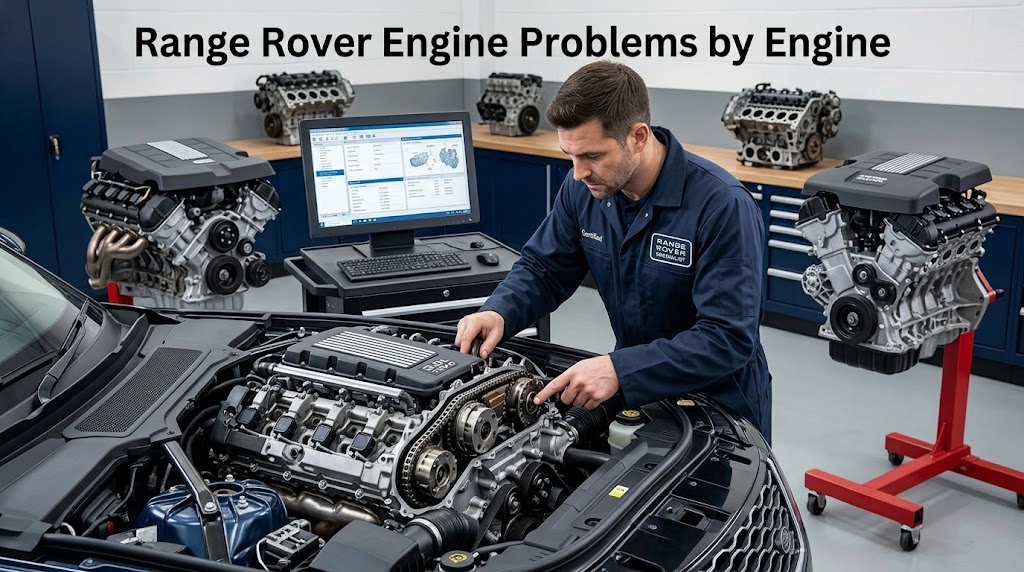
Range Rover engine problems depend on which engine your car has. Supercharged petrol V8s and V6s most often suffer coolant leaks, water pump failures, timing chain wear and supercharger noise, while the diesel V6 and V8 engines are better known for turbo, oil cooler and DPF faults. Identify your engine first, then check its weak points and the warning signs that mean you should stop driving.
Key takeaways
- Identify your engine from the tailgate badge, VIN or registration card before comparing symptoms.
- Coolant leaks from plastic pipes, oil leaks and timing chain wear affect most engine families.
- Diesels used for short trips in Dubai traffic are prone to DPF blockage.
- An oil pressure warning, cold-start rattle or blue or white smoke needs diagnosis before further driving.
- Most faults are repairable; replacement makes sense only when the internals are damaged.
How to find which engine your Range Rover has
Table of Contents
ToggleMost Range Rover models were sold with several engines, and badges are sometimes removed or swapped. Use these three checks.
Tailgate badge. Older cars show names such as Supercharged, TDV6, SDV6 or SDV8. Newer models use codes where P means petrol, D means diesel and the number is power in PS, so a P400 is a 400 PS petrol.
VIN. The 17-character VIN is at the base of the windscreen and on the door pillar. Decoding it with Land Rover diagnostic software or a dealer VIN check confirms the exact engine code.
Registration card. Your UAE registration card (Mulkiya) shows the VIN and model year. If the badge and the VIN disagree, trust the VIN.
Range Rover Repairs Dubai diagnoses and repairs faults on these engines for owners across Dubai.
Range Rover Engine Problems by Engine Family
5.0 supercharged V8 (AJ133)
Used in the L322 (2010–2012), L405 (2013–2021), Sport L320 (2010–2013) and Sport L494 (2013–2022). Range Rover 5.0 engine problems usually start with the cooling system: water pump leaks, plastic coolant pipes and the thermostat housing.
Early engines could develop timing chain tensioner and guide wear, heard as a rattle on cold start. The supercharger drive coupler also wears, causing a rattle or knock at idle.
4.2 supercharged V8 (AJ-V8)
Used in the L322 (2005–2009) and Sport L320 (2005–2009). These cars are well over 15 years old, so age drives most faults. Expect supercharger coupler rattle, water pump and plastic coolant pipe leaks, perished hoses, valve cover oil leaks and timing chain tensioner wear.
4.4 TDV8 and SDV8 diesel
The 4.4 TDV8 was used in the L322 (2010–2012), and the SDV8 in the L405 (2013–2021) and Sport L494 (2013–2017). Weak points include turbocharger failures, oil cooler and coolant leaks, EGR valve faults and DPF blockage.
The earlier 3.6 TDV8 (L322 and L320, roughly 2006–2010) is associated with more serious crankshaft and turbo failures.
3.0 V6 petrol and diesel
The 3.0 supercharged petrol V6 (AJ126) appears in the L405 (2013–2021), Sport L494 (2013–2022) and Velar (2017–2020). Common land rover 3.0 supercharged engine problems are coolant leaks from plastic pipes and the water pump, supercharger coupler noise, and timing chain guide wear causing cold-start rattle.
The 3.0 TDV6/SDV6 diesel was used in the Sport L320 (2009–2013), L405 and Sport L494 (2013–2018). Range Rover V6 engine problems on the diesel include crankshaft and bearing failures on some engines, oil cooler leaks, turbo faults and DPF issues. It uses a timing belt, so an overdue belt change is a real risk.
2.0 Ingenium four-cylinder
The 2.0 Ingenium diesel and petrol engines power the Evoque (Ingenium diesels from about 2015, all engines from 2019), Velar (2017+) and four-cylinder Sport L494 models. Early diesel units are known for timing chain stretch, and the chain sits at the rear of the engine, making the repair labour-heavy.
Diesels used for short city trips also suffer DPF blockage and oil dilution, so the correct oil specification and service intervals matter.
3.0 Ingenium six-cylinder MHEV
The inline six (P360/P400 petrol, D250/D300/D350 diesel) arrived around 2019–2020 in the Sport L494 and L405, then went into the Velar, L460 (2022+) and Sport L461 (2022+). Its 48V mild-hybrid system adds a belt-driven starter generator and 48V battery, and faults there can feel like engine problems.
Long-term data is still limited. Reported issues include coolant leaks and, on diesels, DPF and oil dilution concerns. Check for open recalls by VIN with Land Rover.
BMW-sourced 4.4 twin-turbo V8 (L460)
The P530 in the L460 (2022+) and Sport L461 uses a 4.4 twin-turbo V8 sourced from BMW, with SV versions using a higher-output variant. Range Rover 4.4 V8 engine problems on these cars are not yet well established.
In BMW's own cars, earlier versions of this engine family were known for oil consumption and leaking turbo oil and coolant lines in the hot V between the cylinder banks. With the turbos inside the V, heat soak in UAE summers is worth watching at every service.
Common problems across Range Rover engines
Coolant leaks from plastic pipes
Plastic coolant pipes, thermostat housings and water pump parts turn brittle after years of heat cycling, and 45–50°C summers with heavy AC load and long idles speed this up. Watch for a sweet smell, dried coolant crust around hoses or a low coolant message. Overheating has its own article, so we keep it brief here.
Oil leaks
Valve cover gaskets, oil cooler seals, oil filter housings and rear crankshaft seals are frequent leak points. Oil dripping onto hot exhaust parts causes a burning smell and is a fire risk, so check any fresh leak quickly.
Timing chain wear
Chains stretch and plastic guides wear, especially with extended oil change intervals. The early sign is a rattle for a few seconds after a cold start. Left too long, the chain can jump a tooth and damage the valves.
Turbo and supercharger issues
Turbo failure shows as whistling, lost power, blue smoke or oil in the intercooler pipes. The turbo is often the victim, not the cause: an oil feed problem or blocked DPF can kill a new turbo too. On supercharged petrols, a worn coupler rattles at idle and a failing supercharger bearing whines under load.
DPF problems on diesels
The diesel particulate filter needs sustained driving to burn off soot. Stop-start traffic and short trips stop regeneration from finishing, leading to DPF warnings, limp mode and oil dilution. Many filters can be cleaned; replacement is needed when a filter is cracked or blocked with ash.
How our technicians handle engine faults
Every engine job starts with a diagnostic scan and a check of live data, not a guess. We trace the root cause, such as why a turbo failed rather than simply replacing it, then explain your repair options and the price before any work begins.
Range Rover engine weak points at a glance
| Engine | Used in | Years | Known weak points | Warning signs |
|---|---|---|---|---|
| 5.0 supercharged V8 | L322, L405, L320, L494 | 2010–2022 | Water pump, coolant pipes, supercharger coupler, early timing chain | Coolant loss, idle rattle, cold-start rattle |
| 4.2 supercharged V8 | L322, L320 | 2005–2009 | Supercharger coupler, coolant pipes, water pump, oil leaks | Idle rattle, coolant smell, oil drips |
| 4.4 TDV8 / SDV8 | L322, L405, L494 | 2010–2021 | Turbos, oil cooler, EGR, DPF | Smoke, power loss, DPF warning |
| 3.0 supercharged V6 | L405, L494, Velar | 2013–2022 | Coolant leaks, timing chain guides, supercharger coupler | Cold-start rattle, coolant loss |
| 3.0 TDV6 / SDV6 | L320, L405, L494 | 2009–2018 | Crankshaft and bearings, timing belt, oil cooler, turbo, DPF | Knocking, oil pressure warning, smoke |
| 2.0 Ingenium | Evoque, Velar, L494 | 2015+ | Diesel timing chain stretch, DPF, oil dilution | Rattle, rising oil level, DPF warning |
| 3.0 Ingenium MHEV | L405, L494, Velar, L460, L461 | 2019+ | 48V system, coolant leaks, diesel DPF | 48V warnings, coolant loss |
| 4.4 twin-turbo V8 (BMW) | L460, L461 | 2022+ | Limited data; hot-V oil and coolant lines | Oil consumption, burning smell |
Warning signs that need immediate attention
Overheating. If the temperature warning appears, pull over safely and switch off. Driving on can warp the cylinder heads; our overheating article covers the causes.
Oil pressure warning. Stop the engine as soon as it is safe. Low oil pressure starves bearings and turbos, and continuing to drive can turn a small fix into a replacement engine.
Rattles on cold start. A few seconds of rattle usually points to timing chain tensioner or guide wear. Book a diagnosis within days, not months.
White or blue smoke. Thick, sweet-smelling white smoke suggests coolant is burning. Blue smoke means oil is burning, often from turbo seals or valve stem seals. A flashing check engine light also means stop driving; steady lights have their own article.
What engine repairs typically cost in Dubai
The figures below are typical prices in Dubai, with the top of each range reflecting main dealer pricing. Our prices are typically 30–70% less than main dealer prices.
| Job | Typical Dubai price | Range Rover Repairs Dubai |
|---|---|---|
| Timing chain service, 3.0 V6 petrol (L405) | AED 8,000–14,000 | AED 4,200–9,800 |
| Turbocharger replacement | AED 5,000–15,000 | AED 4,500–10,500 |
| DPF cleaning | From AED 800 | Typically 30–70% less than main dealer prices |
| DPF replacement | AED 5,000–10,000 | AED 3,000–7,000 |
The final price depends on model, engine and parts choice: the lower end of our range reflects OEM-equivalent parts and simpler jobs, genuine parts sit at the upper end, and we confirm the exact price on WhatsApp after diagnosis. The timing chain figures apply to the 3.0 V6 petrol only, not to V8 or diesel engines.
Water pump, oil cooler and engine replacement costs vary too much by engine to quote here. They range from a moderate repair to the most expensive job a Range Rover can need, and we typically charge 30–70% less than main dealers.
Repair or replace the engine?
Most engine faults are repairable. Leaks, water pumps, turbos, DPFs, supercharger couplers and timing chains caught early are repair jobs, even when the engine has to come out for access.
Replacement becomes realistic when the internals are damaged: a spun bearing or failed crankshaft, valves or pistons hit after a chain jumps, or heads and block distorted by severe overheating. Compression, leak-down and borescope checks confirm the damage before you decide.
Then weigh the cost against the car's value and condition, and whether a used, reconditioned or new engine suits you. A used engine with no history is a gamble. If you want to compare components yourself, genuine and OEM options are available from Range Rover parts Dubai.
When to see a specialist
Book a diagnosis now if you notice any of these:
- Coolant level dropping between checks, or a sweet smell after driving
- A rattle, knock or ticking that is louder when the engine is cold
- Oil pressure, coolant or DPF warnings, or the car entering limp mode
- Blue or white smoke from the exhaust
- Oil spots under the car or a burning smell after a drive
- Loss of power, whistling or whining under acceleration
Range Rover Repair in Dubai with Range Rover Repairs Dubai
For Range Rover repair in Dubai without main dealer pricing, Range Rover Repairs Dubai is an independent Range Rover and Land Rover specialist. We are not a dealer and are not affiliated with Jaguar Land Rover. Our technicians use dealer-level diagnostic equipment to read engine fault codes and live data before recommending any work.
We fit genuine or OEM parts and explain the difference, so you choose the balance of cost and specification that suits your car. Our prices are typically 30–70% less than main dealers, we offer pickup and delivery across Dubai, and you receive a clear quote on WhatsApp before work starts.
Whether your engine has a coolant leak, a rattling timing chain, a failing turbo or a blocked DPF, the process for Range Rover engine repair stays the same: find the root cause, explain your options, then fix it properly.
Bottom line
Engine faults on a Range Rover follow clear patterns: cooling and chain problems on the petrols, turbo, oil cooler and DPF problems on the diesels, and limited data so far on the newest engines. Identify your engine, act on warning signs early and get a proper diagnosis before a small leak or rattle becomes major damage.
Book your Range Rover repair in Dubai
Send us your model, year and symptoms on WhatsApp and get a clear quote before any work starts.
WhatsApp +971 52 791 4606Frequently asked questions
Which Range Rover engine is the most reliable?
Condition and service history matter more than engine type. A petrol V8 or V6 with an updated cooling system and a healthy timing chain is generally a safer buy than a high-mileage diesel used mainly in city traffic. Whichever engine you choose, check the service records and get a pre-purchase diagnosis.
What are common Range Rover engine problems?
The most common faults are coolant leaks from plastic pipes and water pumps, oil leaks from gaskets and oil coolers, timing chain wear, supercharger coupler rattle on petrol engines, and turbo and DPF problems on diesels. Which apply depends on your engine and model year, so identify the engine first.
Why does my Range Rover engine rattle on start-up?
A rattle lasting a few seconds after a cold start usually points to timing chain tensioner or guide wear, because oil pressure takes a moment to build. On supercharged petrols, a rattle at idle can also come from a worn supercharger coupler. Have it checked promptly, as a jumped chain can damage the valves.
Is it worth repairing a Range Rover engine?
Usually, yes. Leaks, turbos, timing chains, DPFs and supercharger couplers are repairable without replacing the engine. Replacement only makes sense when bearings, the crankshaft, pistons or valves are damaged, and even then it depends on the car's value. Range Rover Repairs Dubai can diagnose the fault and price both options before you decide.
How do I know which engine my Range Rover has?
Check the tailgate badge first: newer models show codes such as P400 or D300, where P is petrol, D is diesel and the number is power in PS. Because badges can be changed, confirm the engine by decoding the VIN, found at the base of the windscreen and on your registration card.