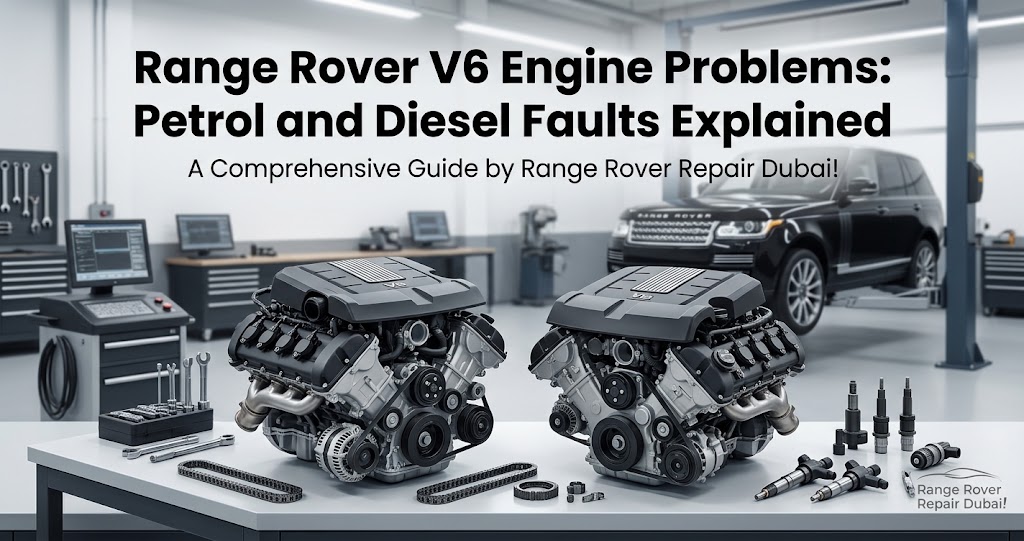
Range Rover V6 engine problems split into two very different groups, because the badge covers two unrelated engines: the 3.0 supercharged V6 petrol and the 3.0 TDV6/SDV6 diesel. The petrol V6 is known for coolant leaks, supercharger coupler noise and oil leaks. The diesel V6 is known for crankshaft concerns on certain build years, turbocharger wear, and EGR and DPF blockage.
Before you act on anything you read online, confirm which engine and which model year you have. The fixes barely overlap.
Key takeaways
Table of Contents
Toggle- Petrol 3.0 supercharged V6: cooling system leaks, supercharger coupler rattle, oil leaks, ignition coil misfires.
- Diesel 3.0 TDV6/SDV6: crankshaft concerns on some early years, turbo wear, EGR and DPF blockage, oil leaks.
- Knocking from the bottom of the engine, a rising temperature gauge or a flashing engine light means stop driving.
- Dubai heat attacks plastic coolant parts and gaskets first, so cooling system condition is the priority on both engines.
- Diagnosis before parts: the same symptom can have three different causes on these engines.
Range Rover Repairs Dubai handles these exact jobs — V6 coolant leaks, supercharger couplers, turbos and timing chains — for owners across Dubai.
Which 3.0 V6 do you have?
The 3.0 supercharged V6 petrol (AJ126) is a shortened version of Land Rover's 5.0 V8 with a Roots-type supercharger. In this region it appears in the Range Rover L405 and Range Rover Sport L494 from around 2014, and in the Velar from 2017 as P340 or P380. From roughly 2019–2020 it was replaced by the 3.0 Ingenium straight-six (P360/P400), which is a different engine with different faults.
The 3.0 TDV6/SDV6 diesel arrived in the Range Rover Sport L320 around 2010, replacing the 2.7, and continued in the L405 and L494. Diesel V6 cars are less common here and are often European-spec imports, so specification varies car to car.
Land Rover 3.0 supercharged engine problems (petrol)
Coolant leaks and the water pump
The cooling system is this engine's weak point in our climate. Plastic coolant pipework, the thermostat housing and the water pump harden with heat cycling, and a slow seep becomes a boil-over in stop-start traffic.
Typical signs are a sweet smell after a drive, dried orange or pink crust around the front of the engine, a low coolant message, or the temperature needle climbing with the AC on full.
Supercharger coupler noise
A rattle at idle and on light throttle, often described as marbles in a can, usually points to a worn supercharger coupler (isolator). This is a wear item inside the drive, not a failure of the blower itself, and it is normally replaced without changing the supercharger unit.
Oil leaks
Valve cover gaskets, oil cooler seals and the rear crank seal are the usual sources. Oil thins in summer heat, so a seep you could ignore in winter turns into a drip onto hot exhaust parts, with the burning smell and light smoke that follow.
Coils, plugs and misfires
Heat-soaked ignition coils are common on these engines. You get a rough idle, a stumble pulling away and an engine light. A flashing light means stop: a live misfire can destroy catalytic converters. Coils and plugs are best replaced as a set by bank, using genuine or OEM Range Rover parts Dubai owners can compare before committing.
How our technicians approach it: we start with a full diagnostic scan and, where relevant, a cooling system pressure test, instead of replacing parts on symptoms alone. Once we have the root cause we explain the options — genuine or OEM parts, repair or replace — and confirm the price before any work starts.
Range Rover 3.0 TDV6 problems (diesel)
Crankshaft concerns on some years
Owners searching Range Rover Sport 2010 3.0 TDV6 problems are usually reading about crankshaft failure. Reports centre on early builds of this engine, roughly 2010 to 2013, where the crankshaft can fail with little warning.
Symptoms are a deep knock from the bottom of the engine, low oil pressure warnings and metal particles in the oil. If you hear knocking, stop driving. Continuing usually turns a repairable engine into a replacement one.
Turbocharger wear
Blocked or coked oil feed lines and stretched service intervals are the usual causes. Listen for a whistle that turns into a siren, watch for blue smoke, loss of boost and limp mode. The turbo arrangement differs between TDV6 and SDV6 versions.
EGR and DPF
Short trips and slow traffic never let a diesel particulate filter regenerate properly, and EGR coolers clog with soot. Expect rough running, warning messages and poor fuel economy. European-spec imports carry a DPF; some regional-spec diesels do not.
Oil leaks and the timing belt
Oil cooler seals, crank seals and turbo oil lines all weep with age and heat. The V6 diesel also uses a rear-mounted timing belt that needs specialist attention at the manufacturer's interval — it is not a lifetime part.
Petrol V6 vs diesel V6: common issues, symptoms and cost
| Engine | Common issue | Symptoms | Cost in Dubai |
|---|---|---|---|
| 3.0 SC petrol | Water pump and coolant leaks | Sweet smell, low coolant, temperature rising in traffic | Mid-range job; we typically charge 30–70% less than main dealers, price confirmed after diagnosis |
| 3.0 SC petrol | Supercharger coupler wear | Rattle at idle and light throttle | Smaller job; typically 30–70% less than main dealers |
| 3.0 SC petrol | Timing chain service | Cold-start rattle, chain-related fault codes | Typical Dubai price AED 8,000–14,000; with us AED 4,200–9,800 |
| 3.0 SC petrol | Coils, plugs, oil leaks | Misfire, engine light, burning oil smell | Smaller jobs; typically 30–70% less than main dealers |
| 3.0 TDV6/SDV6 | Crankshaft failure (some years) | Deep knock, low oil pressure, metal in oil | Major engine work; quoted only after inspection, typically 30–70% less than main dealers |
| 3.0 TDV6/SDV6 | Turbocharger | Whistle or siren, blue smoke, limp mode | Typical Dubai price AED 5,000–15,000; with us AED 4,500–10,500 |
| 3.0 TDV6/SDV6 | EGR and DPF blockage | Warning messages, rough running, poor economy | Varies with cleaning or replacement; typically 30–70% less than main dealers |
| Job | Typical Dubai price | Range Rover Repairs Dubai |
|---|---|---|
| Timing chain service, 3.0 V6 petrol (L405 figures; not for V8 or diesel) | AED 8,000–14,000 | AED 4,200–9,800 |
| Turbocharger replacement | AED 5,000–15,000 | AED 4,500–10,500 |
Our prices are typically 30–70% less than main dealer prices. The final figure depends on model, engine and parts choice — the lower end of our range reflects OEM-equivalent parts and simpler jobs, while genuine parts sit at the upper end — and we confirm the exact price on WhatsApp after diagnosis.
Symptoms and when to stop driving
Some faults can wait for a booking. These cannot:
- Knocking or rumbling from the bottom of the engine, especially with an oil pressure warning.
- Temperature gauge climbing, steam, or a coolant loss message.
- A flashing engine light, which indicates a live misfire.
- Heavy blue or white smoke, or a sudden loss of power into limp mode.
In each case, pull over safely, switch off and arrange recovery rather than driving on.
Looking after a 3.0 V6 in Dubai heat
Summer temperatures of 45–50°C, constant AC load and slow traffic push the cooling system harder than the engine itself. Have coolant condition, hoses, the expansion tank and the pump checked before every summer, not after a warning light.
Shorten oil intervals if the car sits in traffic daily, keep radiator and intercooler fins clear of dust and sand, and fix small leaks while they are still small. On diesels, give the car a longer run regularly so the DPF can regenerate.
When to see a specialist
Book a diagnosis now
New rattle at idle, any coolant loss, oil under the car, a whistle from the turbo, or rough running with a steady engine light.
Bring the history
Service records, recent parts fitted and any stored fault codes save diagnostic time and stop the same part being replaced twice.
Range Rover Repair in Dubai with Range Rover Repairs Dubai
Range Rover Repairs Dubai is an independent Range Rover and Land Rover specialist workshop. We are not a dealership and we are not affiliated with Jaguar Land Rover or any dealer, which is exactly why owners out of warranty come to us for Range Rover repair in Dubai.
We run dealer-level diagnostic equipment, so a V6 fault is identified by testing rather than by guesswork. We fit genuine and OEM parts and explain the difference before you choose, because on jobs like water pumps, couplers and turbos that choice moves the price significantly. Our prices are typically 30–70% less than main dealer prices.
Pickup and delivery is available across Dubai, and you get a clear quote on WhatsApp before any work starts. For Range Rover engine repair — petrol supercharged V6 or TDV6 and SDV6 diesel — that means you know the cause, the options and the cost before a single part is ordered.
Bottom line
The 3.0 petrol and 3.0 diesel V6 are different engines with different weak points, so the first step is confirming which one you have and what year it was built. Once the symptom is matched to the right engine, most of these faults are routine specialist work rather than an engine replacement — provided you act on the warning signs early.
Book your Range Rover repair in Dubai
Send us your model, year and symptoms on WhatsApp and we will tell you what we need to check first.
WhatsApp +971 52 791 4606Range Rover V6 engine problems: FAQs
Is the Range Rover 3.0 V6 reliable?
Both 3.0 V6 engines can give long service with disciplined maintenance, but neither tolerates neglect. The supercharged petrol depends on a healthy cooling system and clean oil. The diesel depends on oil quality, turbo oil supply and proper regeneration. Most failures we see follow skipped services or ignored warning lights rather than the design itself.
What are common problems with the 3.0 supercharged V6?
Coolant leaks from plastic pipework, the thermostat housing and the water pump; supercharger coupler rattle at idle; oil leaks from valve cover gaskets, oil cooler seals and the rear crank seal; heat-soaked ignition coils causing misfires; and timing chain wear on higher-mileage cars. Dubai heat accelerates the cooling and gasket issues first.
What is the TDV6 crankshaft problem?
It refers to crankshaft failure reported on some early 3.0 V6 diesels, where the crank can fail with little warning. Warning signs are a deep knock from the lower engine, low oil pressure and metal in the oil. The exact build years and any manufacturer campaign must be confirmed against your VIN, not assumed from forums.
How much does a V6 water pump replacement cost in Dubai?
It depends on the engine, the parts chosen and whether related pipework, the thermostat housing or the coolant tank need replacing at the same time. We do not quote a blind figure on this job. Our prices are typically 30–70% less than main dealer prices, and Range Rover Repairs Dubai confirms the exact cost on WhatsApp after diagnosis.
Is the V6 or V8 Range Rover better for Dubai?
It depends on how you use the car rather than on one engine being superior. The supercharged V6 is lighter on fuel and puts less heat into the cooling system; the V8 offers more performance and a heavier thermal load. Both need the same discipline here: cooling system care, clean oil and early attention to leaks.